PROCEDURE

Strip Hair Transplant in Phoenix, AZ

For patients who need a larger session — typically 2,000 grafts or more — the strip method often delivers more grafts with less disruption to the overall donor supply than FUE alone.

2,000+

Grafts per strip session

10–14

Days donor healing

6–18

Months growth timeline

1–2mm

Typical scar width

Member, International Society of Hair
Restoration Surgery (ISHRS)

THE PROCEDURE

What the Strip Method Is

The strip method, also called follicular unit transplantation (FUT), removes a narrow strip of donor tissue from the back of the scalp. A surgical team then dissects that strip under microscopes into individual follicular units — the natural groupings of one to four hairs as they grow. Those units are then placed into the recipient area using the same technique used in FUE.
The key difference from FUE is in the donor phase. Rather than extracting hundreds of individual punch sites, one precise incision is made, the tissue is removed, and that incision is closed in a single suture line.

CANDIDACY

Why Strip Is Often the Right Choice for Larger Cases

The conversation about FUE versus strip usually comes down to graft count and donor management.
For sessions in the range of 2,000 to 2,500 grafts or more, the strip method has two practical advantages. First, the total graft yield is higher in a single session — more grafts can be harvested from the same donor region than individual extraction allows in one day. Seco
Dr. Alexander addresses this directly at every consultation for large cases: the strip method is not the older or lesser technique. For the right patient, it is the more conservative one.

HONEST CONVERSATION

The Donor Scar: An Honest Conversation

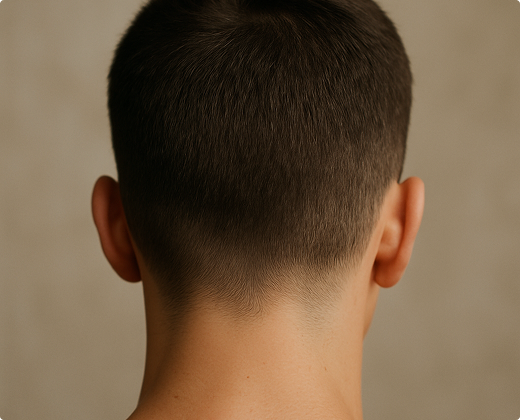
Every hair transplant leaves a donor-area mark. FUE leaves many small round dots. The strip method leaves one linear scar.
With normal suture technique and normal hair length in the donor area, the linear scar is not visible. Most patients can wear their hair at a typical short length without exposure. Patients who plan to shave their heads or wear donor-area hair very short should discuss this directly with Dr. Alexander before choosing the strip method — this is exactly the kind of conversation he has at the consultation. Dr. Alexander also uses a trichophytic closure technique when closing the donor incision, layering the wound edges so that hair follicles can grow back through the closure line itself. This does not eliminate the donor scar, but it further reduces its visibility compared to a standard linear closure, and allows many patients to wear their hair shorter in the donor area than a standard closure would allow.

OUR TECHNIQUE

How Dr. Alexander Performs Strip

Dr. Alexander performs every stage personally: the donor incision, the closure, and the final graft placement. Follicular units are dissected under microscopes and inspected before placement.

Placement uses the same custom-cut blade technique used in FUE: each site is created with a blade matched to the follicle’s dimensions, the graft locks naturally into position, and sites are prepared in advance so the team can evaluate density and angle before the first graft enters.

COMPARISON

FUE vs. Strip at a Glance

FUE

STRIP

Typical graft range
Up to ~2,000
2,000+
Donor mark
Multiple small round sites
Single linear scar
Best for
Earlier loss, short hair preference
Larger sessions, longer hair
Session length
Longer per graft
More grafts per session
Future sessions
Fewer punch sites in donor zone
Scar-area considerations
Typical per-graft cost
Higher per graft
Lower per graft
The right choice depends on graft need, donor characteristics, and personal preference. Dr. Alexander will give you a direct recommendation at the consultation.

COMMON QUESTIONS

Frequently Asked Questions

Does the strip method look less natural than FUE?

No. The result depends on how grafts are placed, not how they were harvested. The custom-cut blade placement technique is the same for both procedures. Natural-looking results are a function of placement quality, not extraction method.

How long is recovery from strip surgery?

The donor area heals over 10 to 14 days. Physical activity is typically restricted for two weeks. The recipient area follows the same 6- to 18-month growth timeline as FUE.

Can I have FUE after a strip procedure, or vice versa?

Yes. Many patients combine procedures across sessions — a strip procedure for a large first session and FUE for subsequent touch-ups, for example. Dr. Alexander plans donor management across the patient’s full hair restoration horizon, not session by session.

What does the strip scar look like?

With proper closure technique, the scar is typically 1 to 2 millimeters wide and lies flat. With hair worn at a standard short length, it is not visible. Dr. Alexander will show you examples at the consultation. This is aided by Dr. Alexander’s use of a trichophytic closure technique, which allows hair to grow through the closure line and further reduces the scar’s visibility.

Schedule a complimentary consultation with Dr. Alexander to evaluate whether FUE, strip, or a combination is right for your case.

Consultations are complimentary for patients 25 and over. Virtual consultations are available.